UK Government response to consultation, here.

Tuesday, February 06, 2024
Tuesday, January 30, 2024
Durchsetzung des § 19a GWB: Erste Erfahrungen und Verhältnis zum Digital Markets Act
A. Stöhr & J. Mendelsohn, hier.
Monday, January 29, 2024
Wednesday, December 13, 2023
#DMACountdown

Three years ago, before the Commission's DMA Proposal was tabled, I had some fun doing a DMA Meme Advent Calendar.

Tuesday, December 12, 2023




Monday, December 11, 2023

Competition and Innovation: Incorporating a More Dynamic Perspective into Enforcement

This is the text of my 15-minute intervention last week at the OECD. Happy I wrote it down and read it because I was a bit overwhelmed, to be honest. Accompanying slides here.
The best part, however, was the interaction we had with the OECD States/competition authorities (despite sitting very far from each other).
"Thank you immensely to the Chair and the Committee for the opportunity to be here with you today. I think that we all in this room might agree that the interplay between competition and innovation is increasingly vital in our economies, in which we all face numerous challenges in devising solutions to ever more complex problems.
These challenges
are starkly highlighted by the ongoing issues surrounding climate change and
the digital revolution. As we know, innovation can be the creative response
that entrepreneurs make to changing conditions, to new challenges. To these
entrepreneurs, “innovation is the ability to see change as an opportunity - not
a threat.” And we as a society, as consumers are provided with choices on how
to deal with these challenges, with these changing conditions. Furthermore, the
critical role of innovation has been profoundly illustrated in our emergence
from the health crisis brought about by COVID-19.
In competition policy circles like this one here, innovation
isn't just a buzzword we throw around to sound smart while prices and output is
what antitrust law is really about. There is a profound and increasing
recognition that innovation is a real
factor in shaping competitive processes and often it should be taken even more
seriously than price effects in competition policy enforcement.
We are very lucky here today to stand on the shoulders of
this excellent background paper prepared by the OECD Secretariat. In my brief
remarks today, I will focus primarily on the highly useful distinction between
the approach that focuses on innovation incentives and the approach that
instead focuses on the innovation impact or innovation effects.
The clear
distinction drawn between a more static and a more dynamic perspective on
innovation is particularly commendable and useful. It effectively highlights
the progress made in terms of competition policy so far, as well as what
remains to be done, both from a theoretical standpoint and in terms of competition
policy enforcement.
Both approaches
have their merits and limitations, and in a certain sense, they are
complementary to each other. Understanding which approach to adopt depends on
the crucial assessment by competition authorities of how competition manifests
itself in the specific market, sector, or industry at stake.
Is the focus on
current or potential competition in identified product markets or is the focus
directly on innovation processes or spaces? This differentiation, as I see it,
is the real focal point of the background paper, from which the brief
considerations I will present in the following emerge.
Although this
differentiation is absolutely crucial and we will return to it shortly, I
believe the two approaches are driven by many insights that are common to both.
I will mention three of these insights here.
The first is the belief
that it is possible for competition enforcers to identify situations, markets in which
innovation is a significant dimension of rivalry between companies.
The second is that
a longer-term or dynamic perspective is necessary to fully grasp innovation and
its relationship with competition.
The third
realization or insight is that a longer-term perspective must contend with
uncertainty. Here we must decidedly forego the comfort of quantifications that
offer the illusion of certainty in the application of antitrust law.
I've created a
table, informed by the background paper and my previous research on this topic.
It outlines key differences between the two approaches, in addition to the
shared insights I've just mentioned.
The first approach
focuses on the circumstance that rivalry in the product market is driven by
product or process innovation. The second approach, on the other hand, brings
directly to the fore the innovation efforts made by competing firms.
This is clearly
evident from the background paper, to which I would only like to add the idea
that it is necessary to also consider the ecosystems where the relative orchestrators
appropriate and manage the innovation efforts produced by the ecosystem
participants.
The following point
relates to the realization that the innovation concerns in the two approaches
are distinct. On one side, there is a reduction or delay in introducing new
features in a product market. On the other, there's a more direct concern
regarding changes to innovation levels and intensity.
The third point is
a focus on financial incentives to innovate by the first approach and on capabilities to innovate in the second.
The fourth point is
that, according to the first approach, future markets can be identified in a
traditional manner. In contrast, based on the second approach, it is not
possible to define markets that may emerge from innovation in such conventional
terms.
The fifth aspect is
that for the first approach, innovation is mostly of an incremental nature,
while the second approach is perhaps more oriented towards innovation that is
mostly of a disruptive nature.
The sixth aspect
relates to different degrees of uncertainty. For the first approach,
uncertainty is linked to the fact that products have not yet entered the market
or potential outcomes from innovation are not clearly identifiable. For the
second, the uncertainty is more radical as it stems from the circumstance that
there is high uncertainty regarding future outcomes of innovation efforts.
The seventh and
final aspect concerns theories of harm. For the first approach,
profit-cannibalization narratives are particularly relevant, thus analogous to
unilateral price effects. Relevant are also traditional foreclosure theories,
which are then adapted to an innovation context. Instead, For the impact-based
approach to innovation and competition, the theories of harm aim to highlight
the direct impact on innovation of a behaviour or a transaction, not merely as a
consequence of a reduction in competition.
Certainly, the
distinction between these two approaches is valuable for analytical clarity and
for promoting theoretical and other developments, but in enforcement practice,
they are often also strategically interconnected, as noted in the background
document.
So, we can
distinguish cases where there is a more static approach to innovation and which
aligns closely with the first approach. This involves determining product
markets, even if they are in the future, even if the competition is only
potential, and then also relying on conventional theories of harm based for
instance on a profit cannibalization rationale.
And then there are
other cases where the approach to competition is more dynamic, both in terms of
determining a product market or an innovation space and in terms of theories of
harm.
In the final part
of my reflection, I concentrate on some challenges that I still see on the
horizon from the perspective of further developing this more dynamic approach
to innovation.
From seven, as in
the previous table, the points I would like to briefly illustrate are now eight.
The first point is
that it seems to me that it’s still necessary to better conceptualize the
relevant rivalry between companies as a process of innovation and knowledge
creation. From this perspective, it is clear that the traditional, orthodox
industrial organization thinking and approaches may provide only limited
assistance. Much more useful could be economic theories that focus on
innovative, dynamic processes of variation and selection, such as evolutionary
economics.
I am absolutely
convinced that these alternative economic conceptualizations of dynamism and
competition processes should receive greater attention from antitrust
enforcers. The monopolization carried out by the industrial organization in the
field of so-called competition economics has so far left little room for this and
other theoretical contenders or even disruptors to emerge.
The second point is
that there is still a significant need to develop a better understanding of
innovation capabilities, especially in sectors where innovation processes are
less structured. This might be the case because, for instance, the tools of
appropriation in theses sectors or market phases might be different from
traditional IP rights. A different understanding of innovation capabilities
might be required based on the specific type of technology/knowledge
production, the specific skills required (for instance, particularly valuable
AI talent), and the specialized assets needed, such as data and specific
technological tools required for innovation.
The third point is
that if a better understanding of innovation capabilities is essential, there
are additional innovation factors beyond capabilities that require attention.
These include dynamic patterns, path dependencies, absorptive capacities, technological
trajectories, and so on.
The fourth point is
that greater efforts may be needed in certain contexts to assess the impact of the
same innovation efforts on multiple sectors (e.g., digital) – cross-market.
A fifth, more
practical challenge is that in some jurisdictions, it may be necessary to
clarify in the law that "market definition" under certain
circumstances is not necessary, or that the market can be determined in a
radically different manner from traditionally employed methods.
A sixth, more
challenging point from a theoretical and analytical perspective is that it
seems necessary to better understand innovation processes within ecosystems.
This, for instance, requires differentiation between the production of
innovation and knowledge and the mechanisms of their appropriation. This
pertains to contexts and ecosystems where both incremental and disruptive
innovation hold significance.
A seventh point to
consider is that it would be important to incorporate concerns about the
"quality" of innovation into antitrust practice, not just focusing on
innovation levels and intensity. From this perspective, close collaboration
with data protection authorities and, in the near future, various types of AI
regulators, including sector-specific ones, could be crucial.
Last but not least,
there is the challenge related to the evidence required to ultimately capture
the innovation dimensions mentioned in the background note. Some are already
practiced, such as portfolios of R&D activities, commercial and licensing agreements
with other companies. Other evidence, for example, to assess innovation
capability, may include the analysis of links to universities, participation in
scientific conferences, and so on.
If the eight
challenges, taken together, may seem a bit daunting, I would suggest that
antitrust authorities join forces on many common fronts. A very practical and
cost-effective suggestion is that one or more antitrust authorities, from
different jurisdictions, could facilitate the organization of symposia,
seminars, and workshops that bring together economists (including those from
non-orthodox economic schools), management experts, behavioural scientists, scientists
from different fields, and technologists. These gatherings would provide a
platform for cross-disciplinary collaboration, offering diverse perspectives,
approaches, and knowledge to enhance the understanding of innovation processes
within specific industries and sectors. They could ideally also lead to the
development of new assessment tools and methodologies immediately relevant to
competition policy enforcement.
And as you see here, fun we had! .jpeg)
.jpeg)
CAPITALISM RECONNECTED: Toward a Sustainable, Inclusive and Innovative Market Economy in Europe
J. P. Balkenende, G. Buijs, here.
Saturday, December 02, 2023
On innovation and competition at the OECD: happy to help, if I can!
.png)
I was only once at the OECD before - as an observer (the topic was Big Data, with Annabelle Gawer and Hal Varian, great fun - my take here).
Next time soon (and determined to enjoy myself, whatever).
Some of the work I've done specifically on this topic (although I stealthily applied evolutionary/innovation arguments in almost everything I wrote):
- Early 2005 article with Wolfgang Kerber (already Doktorvater at that time): EU Competition Policy, Vertical Restraints, and Innovation: An Analysis from an Evolutionary Perspective
- My PhD Thesis in innovation economics started in a pre-digital (?) age: Zur Beurteilung vertikaler Beschränkungen in der europäischen Wettbewerbspolitik aus evolutionsökonomischer Sicht (Münchner Schriften zum Europäischen und Internationalen Kartellrecht) (also second-hand)
- This article summarizing some results of my thesis in French: Une perspective économique évolutionniste à l'égard des restrictions verticales
- This short piece on Android in which I applied a spurious dynamic capabilities approach to ecosystems: Digital Platforms and Antitrust: Towards a More Techno-Economic Approach
- This article about incentives to innovate in the Microsoft EU decision The Incentives Balance Test in the EU Microsoft Case: A More 'Economics-Based' Approach?
- This draft paper with Wolfgang Kerber presented at Ascola 2019 on the concept of innovation spaces in Dow/Dupont: Dow/Dupont: Another Step Towards a Proper Assessment Concept of Innovation Effects of Mergers
- This with Luigi Marengo on IP and evolutionary economics: Dynamic Inefficiencies of Intellectual Property Rights from an Evolutionary/Problem-Solving Perspective: Some Insights on Computer Software and Reverse Engineering
- On an early killer acquisition in the digital sector Open Source and Merger Policy: Insights from the EU Oracle/Sun Decision
- On a dynamic approach for the assessment of buyer power Il potere verticale della domanda
- Short ProMarket piece on Gen AI and innovation: Next-Generation Antitrust Policy in an AI-Driven World
P.S. This topic is particularly dear to me. My interest for it started 30+ y. ago, as a young legal scholar in Milan. After many difficult and depressing years with my mentor at that time, Prof. Denozza, who didn’t understand/support my research interest for this topic and actually hampered me from pursuing it, I wrote to him that I was quitting his School (call it “Family”) to continue my research in Germany, where I did a PhD in economics on the topic of this week’s discussion in Paris (BTW, losing the support of Prof. Denozza's powerful Academic Family totally ruined my academic prospects in Italy but made me who I am. Reminder: Italy is a country in which you might even become a Competition Commissioner - especially if your father is a good friend of a former neo-fascist who happens to be the President of the Senate - not to mention becoming the AI Chief Technological Strategist because you love potatoes recipes)
Wednesday, November 29, 2023
Tuesday, November 28, 2023
Monday, November 27, 2023
Saturday, November 25, 2023
Monday, November 20, 2023
Thursday, November 16, 2023
Wednesday, November 15, 2023
Tuesday, November 14, 2023
Thursday, November 09, 2023
Potential Competition and Partial Acquisitions and Concluding Remarks
Merger Guidelines discussed by nice "Utah" people, Video here.
More:
Wednesday, November 08, 2023


Tuesday, November 07, 2023
Monday, November 06, 2023
Thursday, November 02, 2023
Tuesday, October 31, 2023
Monday, October 30, 2023
Sunday, October 29, 2023
Saturday, October 28, 2023
Wednesday, October 25, 2023
Monopoly Power Is the Elephant in the Room in the AI Debate
M. von Thun (Open Markets Institute), here.
Saturday, October 21, 2023

Thursday, October 19, 2023
Wednesday, October 18, 2023
ICN 2023 Barcelona: Recommended online watching
18 October
- 9.30: Reynders keynote
- 11.15 Khan keynote/interview
- 11.30 Digital mergers;
19 October
- 9 : Coeuré keynote
Tuesday, October 17, 2023
Safeguarding Data and Innovation: Building the Foundation for the Use of Artificial Intelligence
House Committee Hearing, here.
Monday, October 16, 2023
Charting a Course for Global AI Governance: Options and Lessons from Nuclear History
D. Backovsky, J. Bryson, here.
Sustainability and Competition: From Hot Topic to Business As Usual?
Kluwer Competition Law Blog, here.
Friday, October 13, 2023
Thursday, October 12, 2023
Monday, October 09, 2023
Generative AI: the US class action against Google Bard (and other AI tools) for web scraping
Kluwer Copyright Blog, here.
Google’s Commitments under Section 19a of the German Competition Act
Kluwer Competition Law Blog, here.
Saturday, October 07, 2023
Thursday, October 05, 2023
Wednesday, October 04, 2023

Tuesday, October 03, 2023
Monday, October 02, 2023
The New Law of the European Data Market: Demystifying the European Data Strategy
B. Botero Arcila, T. Groza, here.
Leitlinien zu Artikel 102 AEUV – Neue Maßstäbe für die Missbrauchsaufsicht?
Bundeskartellamt, Arbeitspapier hier.

General Purpose AI Systems in the AI Act: trying to fit a square peg into a round hole
C. Boine, D. Rolnick, here.
Tuesday, September 19, 2023
Friday, September 08, 2023
Monday, September 04, 2023
‘Ecosystem’ theories of harm in digital mergers: New insights from network economics
C. Caffarra et al., here.
Open (For Business): Big Tech, Concentrated Power, and the Political Economy of Open AI
D. Gray Widder et al., here
Thursday, August 31, 2023
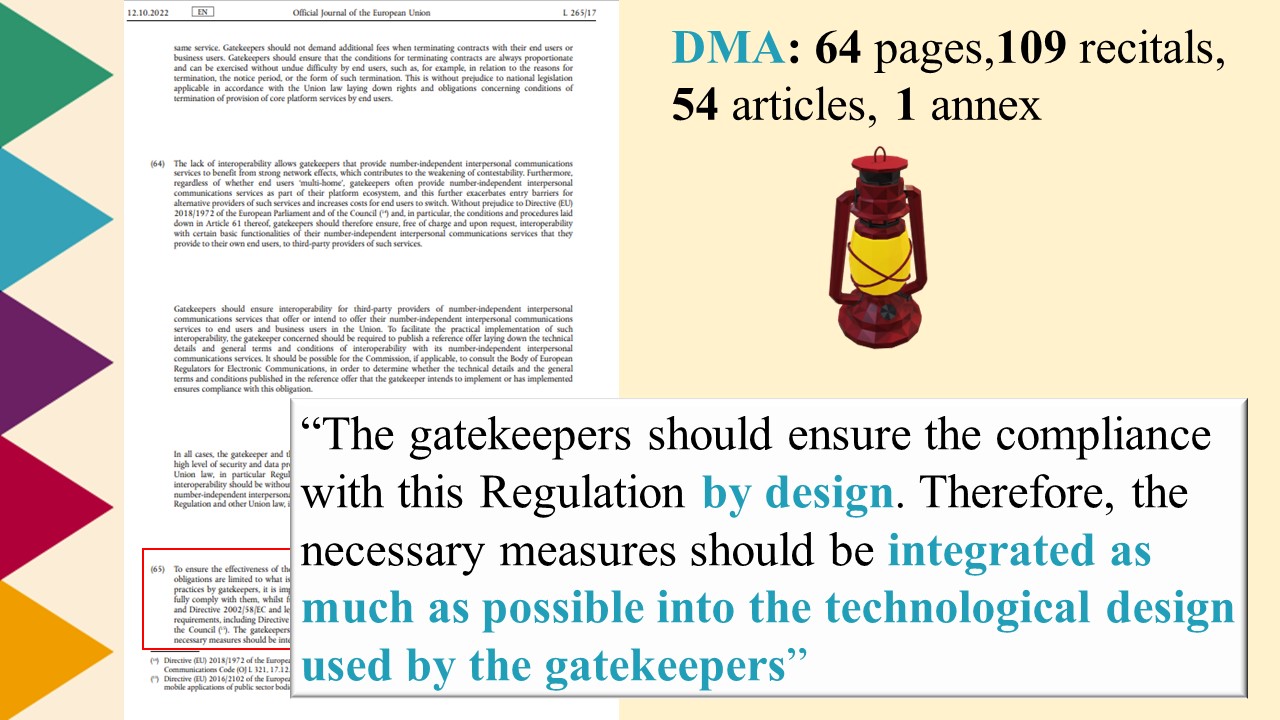
New draft paper: ‘Compliance by design’ with the messenger interoperability obligation under the Digital Markets Act
Me, comments much welcome, here.
BTW, I'll resume posting "properly" next week.
Saturday, August 12, 2023
Friday, August 04, 2023
Subscribe to:
Posts (Atom)